Self-publishing often appears deceptively straightforward—finish a manuscript, upload it to a platform, and wait for readers to arrive. In practice, that assumption breaks down quickly. For first-time authors, writing the book is only one part of a much larger system. The real difficulty begins before publication, where decisions about manuscript structure, formatting precision, platform selection, and market positioning determine whether a book will ever be seen at all.
This is where many new writers miscalculate the process. Self-publishing is not just a creative act; it is a structured publishing workflow shaped by discoverability factors like keyword strategy, metadata accuracy, editing depth, and category alignment. Without understanding these elements, even well-written books can disappear into digital obscurity, receiving minimal visibility and weak reader engagement.
To make things even more interesting, the discipline of writing extends beyond books alone. For example, Script Writing for Documentaries: A Beginner’s Guide follows many of the same foundational principles—clear structure, audience awareness, narrative pacing, and careful editing. Whether you are writing a documentary script or preparing a manuscript for publication, the underlying requirement remains the same: content must be intentionally shaped for its intended audience, not just written and released.
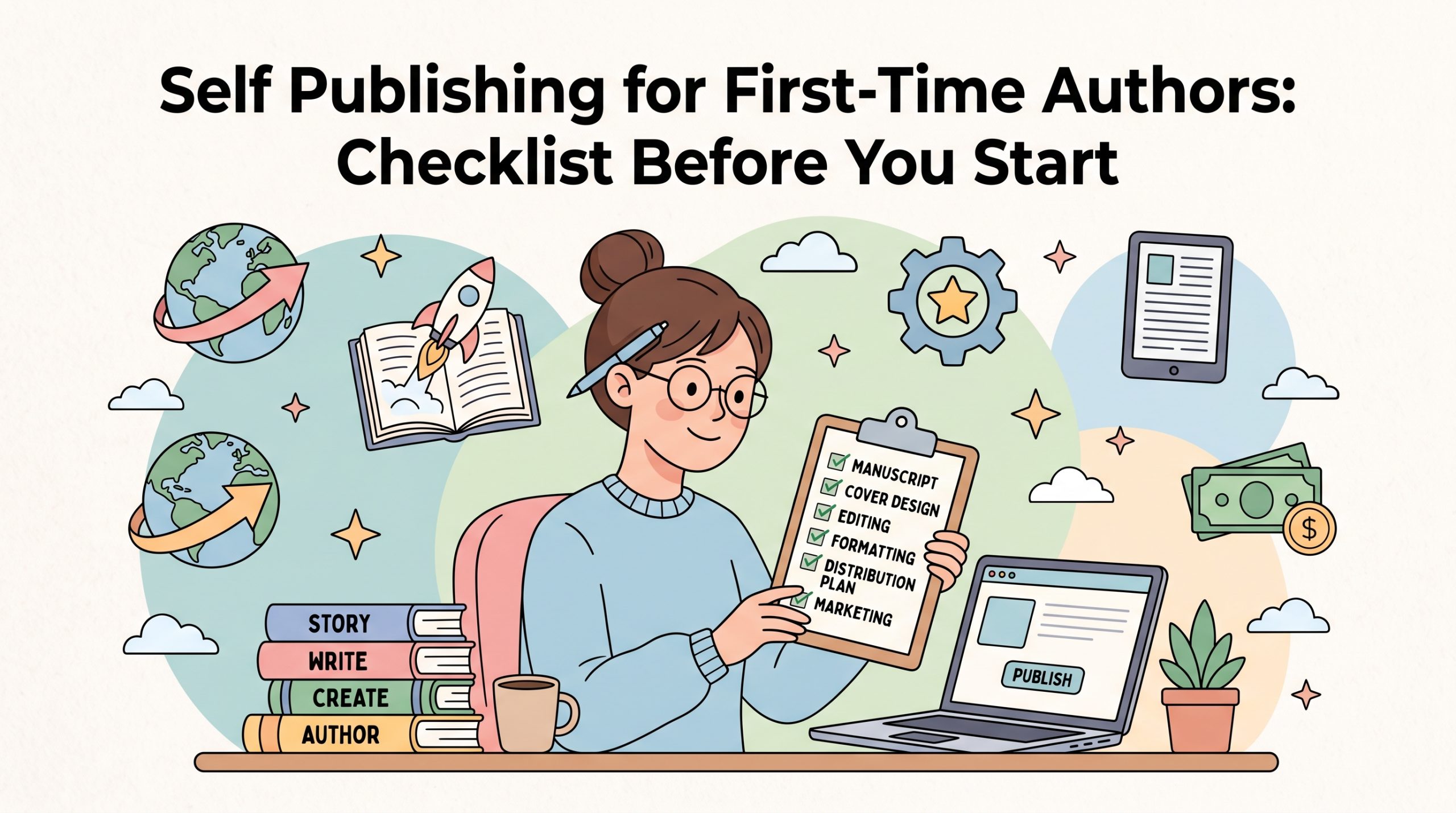
This guide is designed to eliminate guesswork from the self-publishing process. It walks through a practical, experience-based checklist that first-time authors can use before pressing “publish.” From manuscript readiness and layered editing to cover design strategy, formatting decisions, pricing logic, and distribution planning, each step focuses on execution rather than theory.
Ultimately, success in self-publishing depends on treating your book as a structured product rather than a finished draft. Platforms like Amazon KDP and IngramSpark reward preparation, not just creativity. The more intentional the groundwork, the stronger the book’s performance once it enters the market.
Manuscript Readiness: The Stage Most Writers Misjudge
Before anything else, your manuscript must be structurally complete—not just “finished.” Many first-time authors confuse finishing a draft with being publication-ready. In reality, your manuscript must go through refinement layers that ensure clarity, flow, and reader engagement.
A strong manuscript for self-publishing should already reflect consistency in tone, logical progression of ideas, and polished language that aligns with your genre expectations. If you are writing nonfiction, your arguments must be supported with structure; if fiction, pacing and character arcs must feel intentional.
What matters most at this stage is removing “writer thinking” and replacing it with “reader experience thinking.” Readers don’t care about your process—they care about clarity and emotional or informational payoff.
| Manuscript Element | What You Must Check |
| Structure | Clear beginning, development, and resolution |
| Flow | Smooth transitions between ideas or chapters |
| Language | Consistent tone and readable sentence structure |
- Ensure your draft is complete, not partial or idea-based
- Remove repetitive explanations and filler paragraphs
- Read the manuscript aloud to catch unnatural rhythm
A manuscript is not ready for publishing just because it is complete. It is ready when it feels effortless to read.
Editing Layers: Why One Round of Editing Is Never Enough
Editing is where most self-published books either rise or collapse in quality. First-time authors often rely on a single edit pass, usually self-editing, which is not sufficient for professional publishing standards.
In self publishing, editing must happen in layers: developmental editing (structure), copy editing (language), and proofreading (final errors). Each layer serves a different purpose, and skipping one creates invisible weaknesses in the final book.
Think of editing as sculpting: the first pass removes unnecessary bulk, the second refines shape, and the final polish defines surface clarity. Without this process, even strong writing feels unrefined and amateurish.
| Editing Stage | Purpose |
| Developmental Editing | Fix structure, pacing, and logic |
| Copy Editing | Improve grammar, clarity, and sentence flow |
| Proofreading | Remove typos and final surface errors |
- Never publish directly from your first draft
- Use at least one external editor or critique reader
- Separate structural edits from grammar corrections
Editing is not about correcting mistakes alone—it is about elevating readability to a professional publishing standard.
Book Cover Strategy: Your First Marketing Asset
Your book cover is not decoration—it is marketing psychology. In self-publishing, especially on platforms like Amazon KDP, your cover is often the first and only chance to attract a reader.
A first-time author often prioritizes content over cover design, but market behavior shows the opposite: readers judge credibility within seconds based on visual impression. A weak cover reduces click-through rates even if the book content is strong.
Your cover must communicate the genre instantly. A romance novel, a business guide, and a self-help book each follow different visual codes. Ignoring these signals creates confusion and reduces trust.
| Genre Type | Cover Style Expectations |
| Fiction | Emotional imagery, strong typography |
| Business | Clean layout, authority-driven design |
| Self-help | Minimalist, clarity-focused visuals |
- Study bestselling covers in your genre before designing
- Avoid cluttered visuals or overused stock images
- Ensure title readability even in thumbnail size
A strong cover does not just attract attention—it filters the right audience.
Formatting for Self-Publishing Platforms
Formatting is where many first-time authors lose professionalism. Even well-written books can look unpolished if formatting is inconsistent. Self-publishing consultant platforms require specific structural formatting depending on whether your book is an eBook, paperback, or hardcover.
The most important principle is readability across devices. A Kindle reader, for example, experiences your book differently from a printed reader. Fonts, spacing, and chapter breaks must adapt accordingly.
Proper formatting also improves retention. Readers stay longer in books that feel visually comfortable.
| Format Type | Key Requirement |
| eBook | Reflowable text, mobile-friendly spacing |
| Paperback | Fixed layout, margin precision |
| Hardcover | Enhanced spacing and print alignment |
- Maintain consistent chapter heading styles
- Use standard fonts for digital compatibility
- Always preview your book before publishing
Formatting is not technical decoration—it directly affects how your writing is consumed.
Keywords, Categories, and Book Discoverability
Writing a good book is not enough; it must be discoverable. This is where keyword research and categorization become essential in self publishing. Platforms like Amazon rely heavily on metadata to recommend books to readers.
Keywords are not random words—they are search behaviors. Readers type specific phrases when looking for books, and your job is to align your book with those patterns.
Category selection is equally important. Choosing the wrong category places your book in a competitive or irrelevant space, reducing visibility.
| Element | Purpose |
| Keywords | Improve search visibility |
| Categories | Define market positioning |
| Description | Convert browsers into buyers |
- Research keywords used in top-ranking books
- Avoid overly broad or irrelevant categories
- Integrate keywords naturally in your book description
Discoverability is not accidental—it is engineered.
Pricing Strategy and Launch Positioning
Pricing is one of the most miscalculated elements in self publishing, especially for first-time authors who tend to treat it as a final step instead of a strategic lever. In reality, your price is part of your book’s positioning architecture. It communicates authority, market intent, and perceived quality before a reader even samples a page. A poorly chosen price can silently undermine even strong writing.
A lower price can improve early downloads, but it often signals low authority in competitive niches. On the other hand, setting a high price without established credibility or reviews can suppress conversions, even if the content is valuable. The goal is not to guess a “fair” number—it is to align pricing with market expectations, reader psychology, and launch objectives.
A more effective approach is to study comparable titles in your niche and position your book within a realistic and competitive range. This ensures that your pricing supports discoverability rather than working against it. You should also factor in your launch strategy—whether you are prioritizing rapid visibility, long-term revenue, or audience building.
| Pricing Factor | What It Actually Means | Strategic Action |
|---|---|---|
| Genre Benchmarking | Understanding standard price ranges in your niche | Analyze top 20 bestselling books in your category |
| Perceived Value | How readers interpret price as quality | Avoid pricing too low in competitive or expert niches |
| Launch Strategy | Short-term visibility vs long-term positioning | Use introductory pricing or discounts for early traction |
| Book Length & Depth | More content often justifies higher pricing | Align price with word count and content complexity |
| Author Authority | New authors lack built-in trust signals | Start mid-range instead of premium pricing |
- Research pricing patterns in your specific genre before making a decision
- Avoid extreme pricing unless supported by reviews or branding
- Treat pricing as part of your marketing strategy, not a final afterthought
Pricing is ultimately a positioning decision because it influences how readers categorize your book before they even engage with it.
Choosing the Right Self-Publishing Platforms
Different platforms serve different goals. Amazon KDP is dominant for reach, but other platforms like IngramSpark offer wider distribution. First-time authors must understand where their audience is most likely to discover their book.
Platform choice affects royalties, distribution reach, and print quality options. Many authors make the mistake of limiting themselves to a single platform without evaluating long-term growth potential.
| Platform | Strength |
| Amazon KDP | High visibility and control |
| IngramSpark | Wide print distribution |
| Draft2Digital | Multi-platform eBook distribution |
- Start with one primary platform for focus
- Expand distribution after initial performance data
- Understand royalty structures before committing
Your platform is your publishing infrastructure—choose strategically.
Pre-Launch Checklist Before Publishing
Before hitting publish, your book must pass a final readiness audit. This is the stage where most preventable mistakes are caught.
A structured checklist ensures your manuscript, cover, metadata, and formatting are aligned. Skipping this stage often leads to post-publication corrections that damage credibility.
- Final proofread completed with no unresolved errors
- Cover tested in thumbnail view for readability
- Metadata (title, keywords, description) fully optimized
A rushed launch often leads to permanent visibility issues that are difficult to reverse.
FAQ: Self-Publishing for First-Time Authors
1. How long should I prepare before publishing my first book?
Preparation time varies, but most first-time authors benefit from a structured timeline of several weeks dedicated solely to editing, formatting, and market research rather than writing alone.
2. Do I need a professional editor for self publishing?
While not mandatory, professional editing significantly improves readability and credibility, especially for competitive genres where quality standards are high.
3. Can I publish without marketing experience?
Yes, but it is not recommended. Even basic keyword optimization and category selection can dramatically affect visibility and sales performance.
4. What is the biggest mistake first-time authors make?
Publishing too early without proper editing, formatting, or keyword strategy is the most common issue that leads to poor book performance.
5. Is self-publishing profitable for beginners?
It can be, but profitability depends on preparation, niche selection, and long-term consistency rather than a single book release.