Formatting a book is not a single universal process but a technical and design-oriented discipline that shifts dramatically depending on whether the final output is an eBook or a printed paperback. Many first-time authors assume that a manuscript can simply be written once and exported into multiple formats without meaningful adjustment. In practice, however, eBook formatting and paperback formatting operate under entirely different structural rules, production constraints, and design logic systems.
This distinction becomes even clearer when applied to structured narrative writing forms such as Eulogy Writing Templates for Different Relationships, where content must be carefully shaped not only for readability but also for emotional clarity and delivery. Just as a eulogy changes depending on the relationship being described, a manuscript must also be reshaped depending on whether it is intended for flexible digital reading or fixed print presentation.
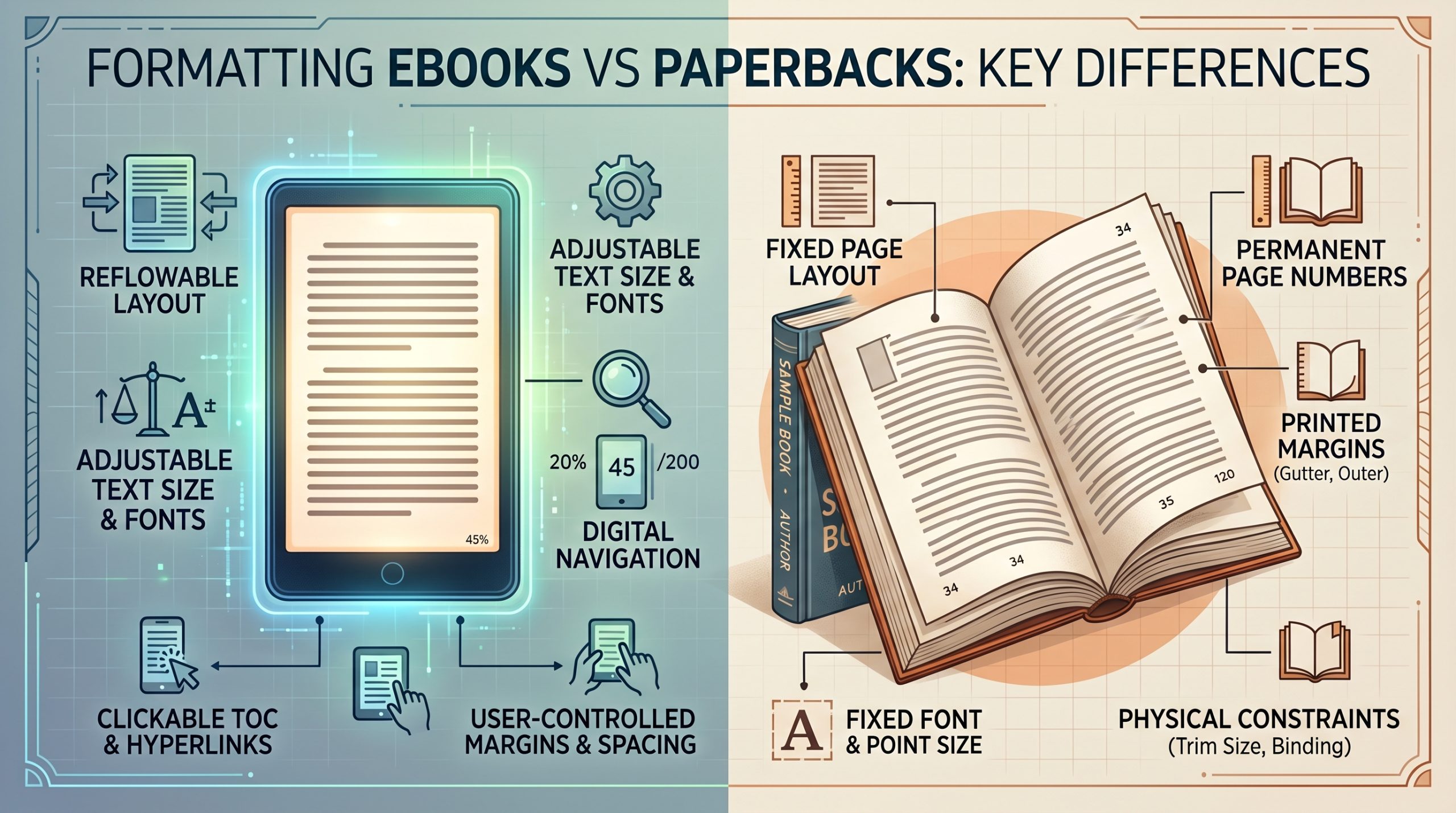
An eBook is designed for digital adaptability, meaning the text must automatically adjust to a wide range of screen sizes, devices, and user preferences such as font scaling and spacing adjustments. A paperback, by contrast, exists as a fixed physical artifact where every element—including typography, margins, page breaks, and image placement—is permanently locked into a predefined layout. This core difference fundamentally influences how the content is structured, how visual hierarchy is managed, and how readers engage with the material across formats.
Understanding these distinctions is essential for anyone involved in book formatting, self-publishing, manuscript design, or digital publishing workflows, because improper formatting can lead to broken layouts, unreadable text, or unprofessional presentation across platforms. A well-formatted book ensures that the reader experience remains consistent regardless of format, while a poorly formatted manuscript can damage credibility and reduce engagement.
Formatting Workflow: From Manuscript to Publication
Understanding the difference between eBook formatting becomes much clearer when you look at how each format is actually produced from start to finish. While both formats begin with the same raw manuscript, the workflow diverges significantly once the text moves into production. Each stage introduces different technical requirements, tools, and quality checks that directly influence the final reading experience.
Manuscript Cleanup Stage (Applies to Both Formats)
Before any formatting begins, the manuscript must go through a cleanup stage that applies equally to both eBooks and paperbacks. This step is often underestimated, but it determines the stability of every downstream formatting decision.
In this stage, the manuscript is standardized into a clean structure. This involves removing inconsistent spacing, eliminating manual line breaks, correcting heading hierarchies, and ensuring that paragraph styles are uniform throughout the document. A clean manuscript also avoids embedded formatting errors that often originate from repeated copy-pasting between tools like Microsoft Word or Google Docs.
At this point, the focus is not visual design but structural integrity. The manuscript is prepared so that formatting tools can interpret it consistently without breaking layout rules later in the process. Whether the final output is digital or print, this step acts as the foundation of professional book formatting and publishing workflow preparation.
eBook Conversion Workflow (Word → EPUB / Kindle Tools)
Once the manuscript is cleaned, the eBook formatting process begins by converting the file into a digital publishing format such as EPUB or Kindle-compatible files like AZW3. This stage is fundamentally about transforming structured text into a reflowable digital format that adapts to multiple devices.
The manuscript is typically imported into specialized tools such as Kindle Create, Vellum, or Calibre. These tools interpret the document’s structure and convert headings, paragraphs, and chapters into HTML-like elements that control digital flow rather than fixed layout. Unlike print formatting, there is no need to control exact page placement because the content will automatically adjust to screen size.
During this process, special attention is given to navigation features such as clickable tables of contents and chapter linking. Images are compressed and optimized to ensure fast loading and compatibility across devices. The final output is then exported as an EPUB or Kindle-ready file and tested across multiple reading platforms to ensure consistency.
Paperback Workflow (Word → InDesign / PDF Print Setup)
The paperback workflow follows a completely different production logic because it is designed for physical printing. Instead of adaptability, this stage focuses on precision and fixed layout control.
After manuscript cleanup, the text is imported into professional layout software such as Adobe InDesign or carefully formatted within Microsoft Word using print-specific settings. The document is then converted into a fixed-page design where every element has a defined position within a physical page structure.
At this stage, decisions such as trim size, margin width, gutter spacing, and bleed settings become critical. Unlike eBooks, where layout adjusts automatically, paperback formatting requires manual control over every page break and text flow decision. Chapters must be positioned carefully to ensure they begin on appropriate pages, and spacing must be adjusted to avoid layout issues such as widows and orphans.
The key principle in this workflow is permanence. Every formatting decision becomes final once the file is exported for printing.
Proofing Stage Differences (Digital Preview vs Physical Proof Copy)
The final stage in both workflows is proofing, but the method of review differs significantly between eBooks and paperbacks.
In eBook formatting, proofing is conducted digitally using preview tools that simulate how the book will appear on different devices such as Kindle readers, tablets, and mobile phones. This stage focuses on checking text flow, navigation links, image scaling, and overall readability across screen sizes. Since eBooks are reflowable, the emphasis is on structural consistency rather than page-by-page accuracy.
This stage highlights one of the most important distinctions in book formatting workflows: eBooks are validated through simulation, while paperbacks are validated through physical output.
Together, these workflow stages show that formatting is not a single technical step but a structured production process that changes depending on the final publishing format. Understanding these differences allows authors and publishers to avoid formatting errors and ensure that the same manuscript performs effectively in both digital and print environments.
The Fundamental Difference Between Digital and Print Formatting
At the core of formatting differences lies a simple but critical distinction: eBooks are fluid, while paperbacks are fixed. This single principle governs every formatting decision made during the publishing process.
In eBook formatting, the content is designed to reflow automatically based on screen size, device type, and user preferences. Readers can adjust font size, line spacing, and even background color. As a result, the designer does not control the exact appearance of each page. Instead, the focus is on creating a clean, structured manuscript that remains readable under all conditions.
Paperback formatting operates in a completely different environment. Once a page is designed, it does not change. The text is locked into a fixed layout where every margin, line break, and spacing decision must be manually controlled. This makes print formatting closer to graphic design and layout engineering than flexible text styling.
This difference affects not only how the book looks but also how it is constructed from the ground up. A manuscript that works perfectly in print may break entirely in digital form if it is not properly converted, and vice versa.
eBook Formatting: Structure Built for Flexibility
eBook formatting is centered around adaptability. The goal is to ensure that content remains readable and visually consistent regardless of device or user settings. Unlike print books, where layout is visually fixed, eBooks rely on structural formatting rather than visual design.
How Reflowable Text Shapes eBook Design
The most important concept in eBook formatting is reflowable text. This means that paragraphs automatically adjust based on screen size and user preferences. A sentence that appears on one line on a tablet may break into multiple lines on a smartphone. Because of this, eBook formatting avoids rigid positioning and instead focuses on clean structural hierarchy.
Fonts are often not fully controlled by the author, as many reading platforms allow users to override typography settings. This means designers must prioritize readability over decorative formatting. Excessive styling can create inconsistencies or even cause formatting errors across devices.
Navigation and Digital Reading Behavior
eBooks rely heavily on internal navigation systems. Readers do not physically flip pages but instead scroll or tap through chapters. As a result, structural elements such as headings, chapter markers, and linked tables of contents become essential.
A well-formatted eBook includes a clearly structured hierarchy that allows readers to jump between sections easily. This includes properly defined chapter headings, consistent paragraph styles, and metadata tagging that supports digital indexing.
Image Handling in eBooks
Images in eBooks must be optimized for multiple screen sizes and resolutions. Large image files can slow down loading times or appear distorted on smaller devices. Therefore, images are typically compressed and scaled to ensure compatibility.
Unlike print books, images in eBooks are not fixed to specific page locations. They flow with the text and adjust dynamically depending on screen size. This requires careful placement to ensure they remain relevant to surrounding content regardless of how the text reflows.
Paperback Formatting: Precision in Physical Layout
Paperback formatting is defined by permanence and spatial precision. Every element on the page is fixed, which means the designer has full control over how the book appears but must also account for strict technical constraints.
Fixed Layout and Page Control
Unlike eBooks, paperbacks do not adjust based on reader preferences. The size of the page, font placement, margins, and spacing are all permanently defined during the formatting process. This requires careful planning to ensure that content flows naturally from page to page without awkward breaks.
One of the most important aspects of paperback formatting is pagination control. Chapters must begin at appropriate positions, and text must be adjusted to prevent widows and orphans, which are single lines of text isolated at the top or bottom of a page. These small details significantly impact the professional appearance of the book.
Typography as a Design Element
In print books, typography plays a much more visible role than in eBooks. Since the designer has full control over the layout, font choice, spacing, and alignment become part of the reading experience itself.
Line spacing is carefully adjusted to improve readability, while font pairing may be used to distinguish headings from body text. Unlike eBooks, where users may override font settings, paperback typography is fixed and must be carefully optimized for print clarity and aesthetic balance.
Image Placement and Print Requirements
Images in paperbacks require significantly more technical preparation than in eBooks. Print-quality images must meet high resolution standards, typically around 300 DPI, to ensure clarity. Additionally, images must be converted into the correct color format, usually CMYK, for accurate printing results.
Placement is also critical. Images must align within margin boundaries and account for bleed areas, which are extra spaces beyond the trim edge of the page. Any misalignment can result in cropped or misprinted visuals.
Technical File Requirements for Each Format
The technical foundation of eBook and paperback formatting is completely different, which is why a single manuscript cannot be directly used for both formats without conversion.
eBooks are typically built using formats such as EPUB or AZW3. These formats rely on HTML and CSS-like structures that define how content flows rather than how it looks. This makes them flexible but also dependent on clean, well-structured markup.
Paperbacks, however, require print-ready PDF files. These files must include fixed dimensions, embedded fonts, and precise layout positioning. Once exported, the file becomes a static representation of the final printed book.
This difference means that authors must prepare two separate versions of the same manuscript, each optimized for its intended format.FAQs
Why do eBooks and paperbacks require different formatting?
Because eBooks are designed for flexible digital reading while paperbacks are fixed physical objects with strict layout requirements.
Can I use the same manuscript for both formats?
Yes, but it must be reformatted separately to meet the technical requirements of each publishing format.
Which format is harder to design?
Paperback formatting is more precision-driven, while eBook formatting requires structural flexibility and adaptability.
Why does my eBook look different on each device?
Because eBooks are reflowable, meaning text adjusts based on screen size and user settings.
What is the biggest mistake authors make when formatting books?
The most common mistake is treating eBook and paperback formatting as identical processes instead of separate systems.
Conclusion
Formatting eBooks and paperbacks requires two fundamentally different approaches to book design. One prioritizes flexibility, digital structure, and adaptability across devices, while the other focuses on precision, fixed layout control, and print production standards. Understanding these differences is essential for producing a professional-quality book that performs well in both digital and physical formats.
A properly formatted manuscript ensures that readers experience the content exactly as intended, whether they are reading on a screen or holding a printed copy. In modern publishing, mastering both formats is not optional but a core requirement for successful book production and self-publishing strategy.