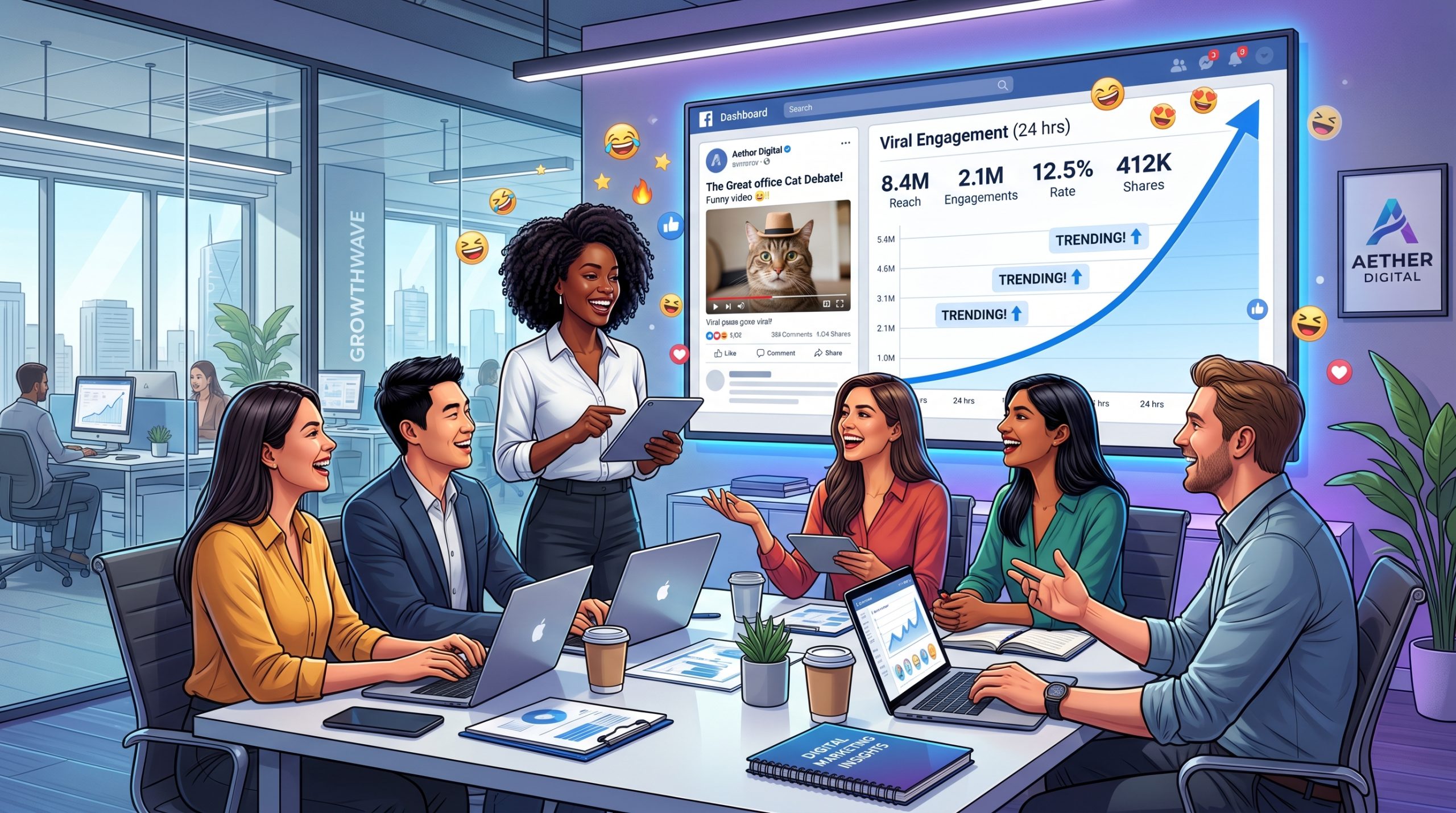
Marketing has changed its center of gravity. Where brands once competed for attention through polished visuals, aspirational messaging, and carefully controlled corporate tone, they are now increasingly investing in something far less predictable but far more effective: humor. Content that makes people laugh has become one of the most valuable assets in digital marketing because it does something traditional advertising struggles to achieve consistently—it earns attention without demanding it.
In a digital environment defined by constant scrolling, fragmented attention spans, and overwhelming content saturation, humor has emerged as a shortcut to engagement. It lowers resistance, disrupts passive consumption, and creates emotional resonance in a matter of seconds. For brands, this is no longer just a stylistic choice; it is a strategic necessity shaped by how people actually behave online.
Understanding why humor-driven content is being prioritized requires looking beyond surface-level virality and into the deeper mechanics of attention, memory, and social sharing. In many ways, this reflects the same communication challenge explored in Philosophy Content: How to Make Abstract Ideas Accessible to General Readers, where success depends on translating complex ideas into forms that people can process quickly, engage with meaningfully, and retain. Just as philosophy writing must bridge abstraction and clarity, modern marketing must bridge strategy and immediacy—delivering messages that resonate instantly without sacrificing depth or intent.
The Attention Economy Has Become Emotionally Selective
Modern audiences are not lacking in exposure; they are overloaded with it. Every platform is saturated with promotional messages, product claims, and lifestyle imagery competing for the same limited cognitive space. In this environment, attention is no longer captured through volume or repetition but through emotional interruption.
Humor functions as one of the most effective forms of interruption because it breaks predictable consumption patterns. When users encounter something funny, they pause—not because they were instructed to, but because the content creates an unexpected emotional shift.
Unlike traditional advertising, which often asks for attention directly, humor earns it indirectly. This distinction is critical. People actively avoid content that feels like an obligation, but they willingly engage with content that feels like entertainment.
Why Humor Works Better Than Traditional Advertising Logic
At a psychological level, humor reduces perceived effort. It signals that content will not demand complex processing or emotional labor, which makes users more willing to engage.
However, the effectiveness of humor in branding goes beyond immediate engagement. It also strengthens memory retention. People are significantly more likely to remember information that is associated with emotional reactions, especially laughter, because emotional stimuli create stronger cognitive encoding.
This means that a humorous brand message is not just more likely to be seen; it is more likely to be remembered long after it is encountered.
Humor also reduces psychological resistance. Traditional advertising often triggers defensive skepticism because audiences are aware of persuasive intent. Humor temporarily lowers that barrier by shifting the interaction from persuasion to entertainment, making the message feel less intrusive and more voluntary.
The Rise of Shareable Identity Content
One of the most important shifts in digital behavior is that people no longer share content only because it is informative; they share it because it reflects something about themselves. Humor plays a central role in this shift because it allows users to signal personality, taste, and social alignment.
When someone shares a funny brand post, they are not just distributing content—they are expressing identity. They are signaling that they understand the joke, belong to a cultural context, or align with a particular tone of communication.
This transforms humor from a marketing tactic into a social currency.
Brands that understand this dynamic are not simply creating ads; they are creating content that people want to associate themselves with. That is a fundamentally different form of marketing leverage.
Why Brands Are Willing to Pay a Premium for Humor-Driven Content
The increased investment in humorous content is not based on trend-following alone. It is driven by measurable performance advantages across multiple marketing goals.
- Humor increases engagement rates by encouraging likes, comments, and shares without requiring explicit calls to action
- It improves organic reach because algorithms prioritize content that generates rapid interaction
- It lowers acquisition costs by reducing dependence on paid distribution
- It strengthens brand recall through emotional association rather than repetitive exposure
- It increases content lifespan because humorous posts tend to resurface and recirculate over time
What makes humor especially valuable is its scalability across platforms. A well-executed humorous concept can be adapted into short-form video, meme formats, captions, and even campaign storytelling, allowing brands to extract multiple assets from a single creative idea.
This efficiency makes humor not just creatively attractive but economically strategic.
The Shift From “Brand Voice” to “Brand Personality”
Traditional branding focused heavily on consistency, control, and message discipline. However, modern audiences respond more strongly to personality than to formal identity systems. Humor allows brands to appear more human, less rigid, and also with the help of modern digital marketing.
This shift is particularly important in social media environments where users expect interaction rather than broadcasting. Brands that maintain overly polished or corporate tones often appear disconnected from platform culture, while humorous brands feel embedded within it.
In many cases, humor becomes the mechanism through which brands translate identity into relatability.
The Risk Factor That Makes Humor Valuable
Humor is not guaranteed to work, which is precisely what makes it powerful. Unlike standardized marketing formulas, humor requires cultural awareness, timing, and contextual sensitivity. When it succeeds, it creates disproportionate impact relative to cost. When it fails, it often becomes forgettable rather than damaging.
The Risk Factor That Makes Humor Valuable
Humor occupies a rare position in marketing because it does not behave like a predictable system. Unlike structured advertising models that rely on repetition, controlled messaging, and stable performance patterns, humor introduces variability into every stage of content creation and audience response. That variability is not a weakness in this context; it is the condition that allows humor to generate disproportionate impact when it succeeds.
At its core, humor functions as a high-variance strategy. It can either underperform completely or outperform traditional campaigns by a wide margin, and this imbalance is exactly what makes it strategically important for brands operating in attention-driven environments.
Why Humor Cannot Be Fully Controlled
Humor resists standardization because it depends on factors that cannot be fully stabilized in advance. Unlike conventional marketing assets, it does not follow a fixed formula that guarantees consistent results across contexts.
- Cultural interpretation changes across audiences, platforms, and time, making humor highly context-dependent rather than universally transferable
- Timing and delivery conditions heavily influence whether humor is received as engaging, irrelevant, or ineffective
This lack of predictability means humor must be treated as adaptive rather than mechanical, requiring continuous adjustment based on audience behavior and cultural signals.
Why Failure Is Usually Low Damage but High Frequency
One reason brands are increasingly willing to experiment with humor is that failure rarely leads to severe consequences in digital environments. Most humorous content either performs well or simply fades without impact, rather than causing sustained negative outcomes.
- Underperforming humor typically results in low engagement and quick content disappearance rather than reputational damage
- The low production cost of digital content allows brands to absorb frequent creative failures without significant financial or strategic loss
This creates a safe experimentation zone where brands can test multiple comedic approaches without long-term risk accumulation.
Why Successful Humor Produces Disproportionate Returns
The value of humor becomes most visible when it works at scale. A single successful piece of humorous content can outperform multiple traditional campaigns because it activates several engagement mechanisms simultaneously.
- Humor increases attention retention, emotional response, and sharing behavior at the same time, amplifying organic reach beyond paid distribution limits
- Successful humorous content often spreads independently of brand channels, extending its lifecycle and audience exposure far beyond initial expectations
This asymmetry between effort and outcome is what makes humor economically attractive despite its unpredictability.
Why Brands Accept This Risk–Reward Imbalance
The growing investment in humor-driven content reflects a strategic shift in how brands evaluate performance potential versus execution certainty. Rather than prioritizing guaranteed outcomes, many brands now prioritize high-upside possibilities within attention-driven platforms.
The acceptance of this imbalance is based on a clear trade-off: controlled advertising offers stability, but humor offers scalability when it succeeds, even if success is not guaranteed.
As a result, humor has evolved from a creative experiment into a calculated risk strategy, where variability is not avoided but actively used as a source of competitive advantage.
The Creative Economy Behind Humor Content
As demand for humorous content increases, so does the value of creators who can consistently produce it. Writers, meme strategists, short-form video editors, and social media creatives who understand comedic timing and cultural nuance are becoming central to modern marketing teams.
Brands are not only paying for execution but for interpretive skill—the ability to understand what audiences find funny in specific contexts and translate that into branded communication without making it feel forced.
This has created a new category of content work where creativity is measured not only by aesthetics but by emotional responsiveness and cultural intelligence.
Conclusion
Humor has become a high-value currency in modern marketing because it operates in a space where certainty is no longer the primary advantage. In environments shaped by rapid scrolling, fragmented attention, and constant content overload, predictable messaging struggles to stand out, while emotionally disruptive content gains visibility more naturally.
The true strength of humor lies in its imbalance. It is not designed for consistent performance, but for exceptional moments of impact that exceed standard marketing outcomes. This makes it inherently volatile, yet strategically powerful when aligned with audience expectations and cultural timing.
Brands are increasingly willing to accept this volatility because the return profile is fundamentally different from traditional advertising. Instead of steady, incremental gains, humor offers the possibility of accelerated reach, stronger engagement, and organic amplification that cannot easily be replicated through structured formats.
Frequently Asked Questions
Why does humor perform better than traditional marketing content?
Humor performs better because it reduces resistance to engagement, increases emotional retention, and encourages voluntary sharing. Unlike direct advertising, it does not feel like an interruption, which makes audiences more receptive to it.
Is humor suitable for all types of brands?
Not all brands can use humor in the same way. While most industries can incorporate some level of personality-driven content, the tone and execution must align with brand identity, audience expectations, and cultural context.
Does humorous content always go viral?
No, humor does not guarantee virality. Its effectiveness depends on timing, relevance, audience alignment, and execution quality. However, when it does succeed, its reach is often significantly higher than non-humorous content.
Why are brands investing more in meme-style content?
Meme-style content spreads quickly because it is easy to consume, highly relatable, and culturally adaptive. It allows brands to participate in online conversations rather than simply broadcasting messages.
Can humor damage a brand’s reputation?
Yes, if it is misaligned with audience expectations or culturally insensitive. However, when executed carefully, humor generally strengthens relatability rather than harming reputation, especially on social platforms where personality-driven content is expected.